30
Jan 13

Love Tester 1985 and the St. Louis Global Game Jam 2013

Matching Hearts

Over the weekend of Jan 25-27, 2013 I co-organized and participated in the St. Louis Global Game Jam 2013. See my posts over at http://www.stlgamejam.com for more posts by me. I’m particularly proud of this post: http://www.stlgamejam.com/everyones-a-designer/, which is about what the role of a designer is at a Game Jam.

Our jam site was the 19th biggest in the world, and the 4th largest in the United States. We had 143 registered participants, and created 20 games altogether.

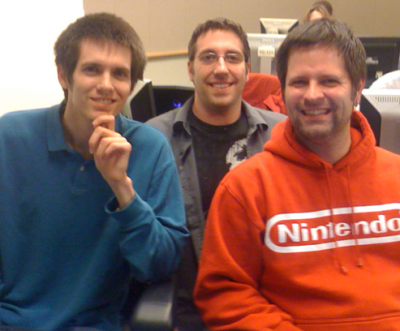
My team consisted of me, Andrew Rauscher, Clayton, Maxwell Oldt, Jordan Covert, and Giovanni Baldi. We team used Sifteo Cubes as the target platform. I bought a set in December, and I’ve been thinking about how having three cubes would make an awesome two player game where each player has a cube and the third cube sits between them as a scoreboard. This was a perfect opportunity to create a game like that and learn a bit of C++, which nobody on the team had ever coded in before the event. It was challenging to move outside of my comfort zone, but it was extremely gratifying to learn what I’m capable of learning and producing in just 48 hours.

photo(4)

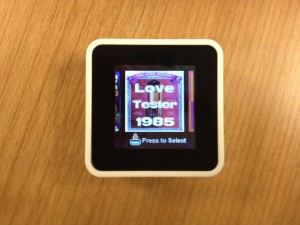
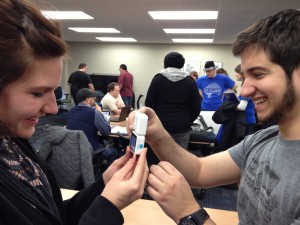
The theme of this Game Jam was “sound of a beating heart”, and our team interpreted that as the feeling of being in love. As a result, the game we created is Love Tester 1985. It’s a game that’s meant to be played by lovers/potential lovers. Love Tester 1985 is structured as a series of cooperative mini-games where a pair can only win by communication,  knowing each other, and working together.

  photo

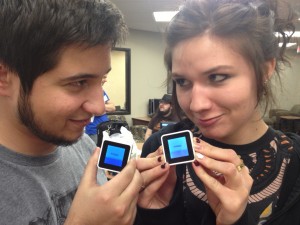
The game begins by having the players put their cubes together to form a heart. When they do this, the game notices and a heart on the scoreboard lights up. A few seconds later, the first game begins. This gets the players used to interacting with each other using the cubes and gets them in the mood to play cooperatively.

The first mini-game is a question that tests how well the players know each other. Each of the cubes displays “Me” and “You”, but one of the words is upside down so the player has to flip their cube over in order to highlight their answer. For example, if the question is “Who is more ‘experienced’?” one of the players might hold the cube so that it reads “Me”, and the other would hold it so that it reads “You,” and when the players press their cubes together they would win the mini game. The hope is that the couples talk about the results and get to know each other better or playfully fight about the answer.

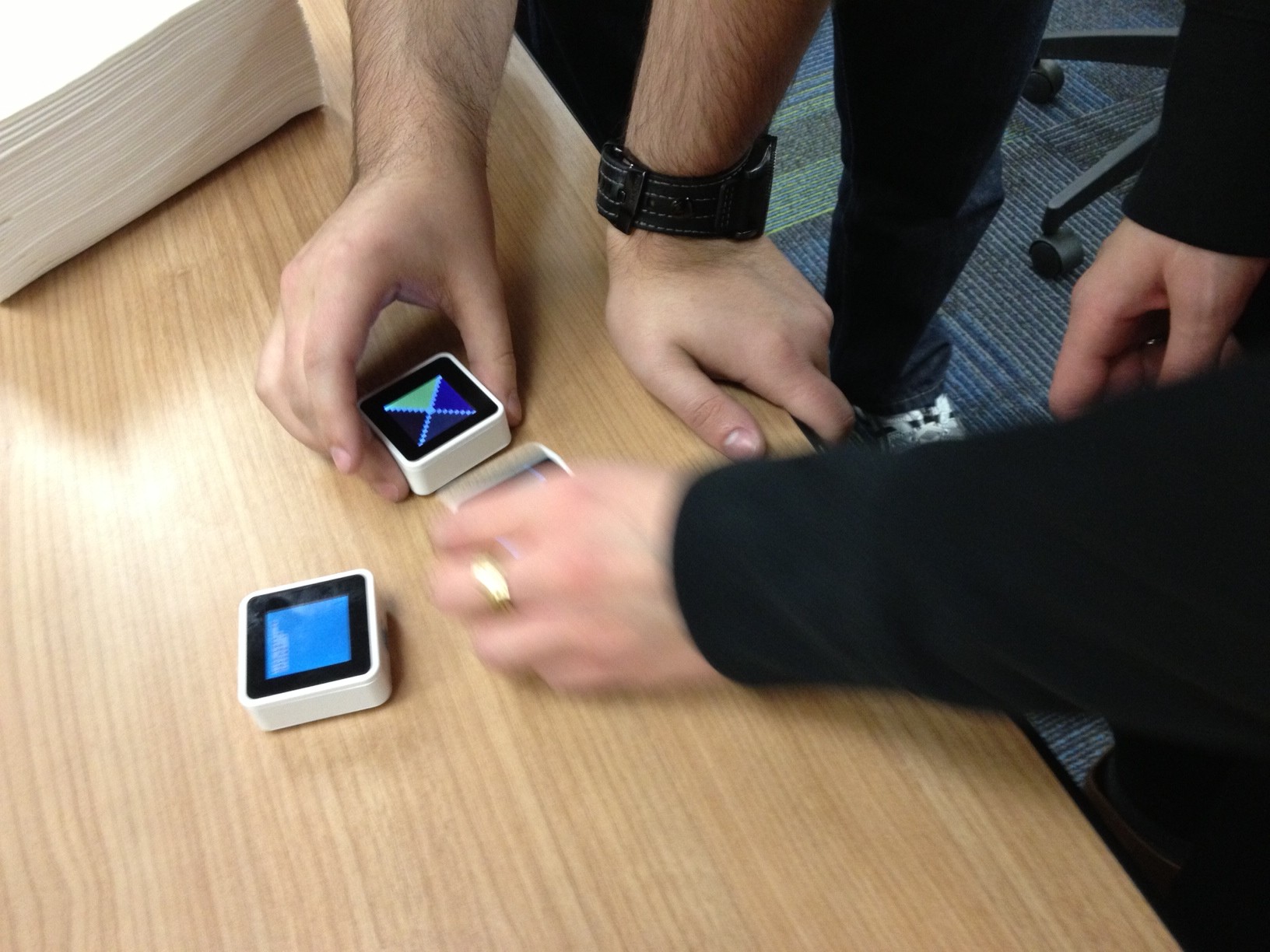
Next up is a super fun cooperative dexterity mini game. In this mini game the players’ cubes show a different color on each of the four sides and the center cube shows a solid color. The players need to push their cubes together so that the color of the touching edges matches the color of the center cube. When they do this, the color on the center cube changes and they need to quickly rotate their cubes to match again. This is really fast paced and fun! We got this game working on Friday night and immediately knew we were onto something.

photo(3)Next up is another question round, just like the first game. This is followed by a communication game where each player’s cube has a four-sided shape that they hide from the other player and attempt to explain which edge fits into one of the edges of the other player’s cube without peeking. This is a unique use of the cubes, and an interesting design since it relies on the players willfully hiding information from each other to be fun.

photo(2)photo(1)

When the players are done with this game, their total score is tallied up and they are given a “Love Tester” like label, such as “Hot Stuff” or “Frigid”.

This is as far as we got during the Game Jam, but ideally we’d like to polish some of these games and make even more mini-games. Thankfully, we might have that opportunity! There’s a contest that I’m using this post to enter, and if we make it to the second round, Andrew and I are going to put some time into making these games even cooler and adding in some of the other mini-game ideas that we liked.

If you happen to have a set of these cubes you can download and install our game right now (it doesn’t play well in the Sifteo cubes simulator):

http://www.superwes.com/lovetester/loveTester1985.zip

Also check out a video of people playing it!

* Special thanks to Jason Lemons and Kayli Elizabeth for modeling in these screenshots


17
May 11

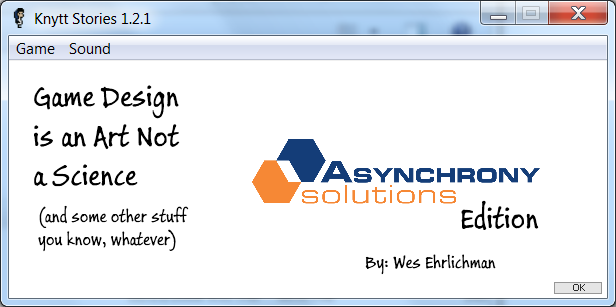
Game Design as an Art, not a Science

Shortly after my game/lecture on Game Design Using In-Game Editors a call went out for lunch and learn presentations at my work. I wanted to expand the audience for my talk so I decided to give the same lecture again, figuring it wouldn’t take much effort. After committing to present, I went back and played the game again only to realize that the topic didn’t translate perfectly to my new audience. The programmers at work might share the same desire to make games, but they’re definitely more the type of people who want to make games as a programming challenge rather than a design one.

I decided to modify my game in an attempt to challenge their preconceptions of what makes a good game. I’m not sure how successful I was, but if nothing else, this new version prompts discussion, as it asserts a lot of somewhat controversial things about what constitutes good game design. Unlike my previous demo, I’ve published the text of the game below. In my previous post I explained how to download Knytt and play the level, so go back to that post if you’d like to play the game.

The updated files for this new talk are:

I’m assuming most of you won’t play the game though, so I’ll go ahead and post the text of the game below for all the lazy folks out there. As you read through these pretend like each one is on a sign post in the world.

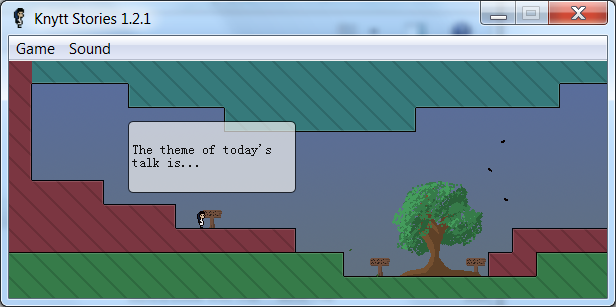
  • The theme of today’s talk is…
  • Game Design is an art, not a science. Don’t let technology prevent you from making games.
  • And. Uhh, press “S” to Jump. (That’s not the theme)
  • You don’t have to be a programmer to try your hand at game design.
  • This may seem obvious, but if you’re like me, the technical hurdles sometimes scare you from getting started.
  • Creating is hard work, and if you want to make a game, the amount of effort may not seem worth it.
  • When that happens, we can handle it in a few ways:
  • (For this lecture we’re ignoring the “man the hell up and learn something” option)
  • <- Create using something easy
  • Never create anything ->
  • Good choice! Going the other way has never solved anything.
  • Today I will show you one of the simplest and most versatile tools I know of to make a platformer.
  • Some of what I show will hopefully inspire you. This presentation was made in just a few nights.
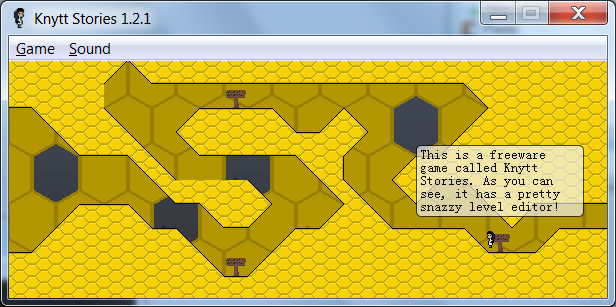
  • This is a freeware game called Knytt Stories. As you can see, it has a pretty snazzy level editor!
  • The game isn’t actually about reading signs, I made it like this because it’s more fun than PowerPoint.
  • Go to the next room and grab the high jump!
  • This lets you jump higher so that you can reach taller platforms.
  • You could probably use this in some pretty advanced designs, right?
  • To advance from here you’ll need to climb a wall. Get the wall climb!
  • Shoot! someone must have “forgotten” to put in the wall climb ability!
  • Better go to the level editor and add it.
  • Put Object 4 from Bank 0 on layer 4. Don’t forget to save before quitting! (press down when on the light)
  • So yeah, that was the level editor. You can also add in enemies, people, hazards, and pretty birdies.
  • You may have thought about how cool it would be to make a game like this before.
  • You probably thought it was too hard. From scratch it is! But using this you can design one easily.
  • Moves like a high jump, wall climb, super speed, and umbrella are very inspiring.
  • It was super easy to throw this together and it’s even easier to do something that’s actually fun!
  • I’m not trying to sell you on Knytt, just that you that you don’t need to program to design games.
  • Now that you’re 100% convinced, let’s talk more about game design.
  • Game Design is more about psychology than physics engines.
  • This is why there is a need to inspire non-programmers to experiment with game design.
  • And this is why tools like this one are becoming ever more important.
  • A game with good design teaches the player how to play without realizing that they’re learning.
  • This doesn’t happen in the programming, it happens in the content creation.
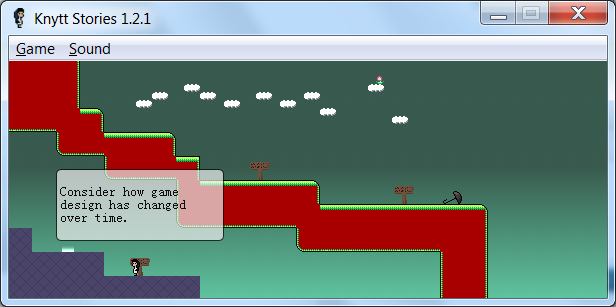
  • Consider how game design has changed over time.
  • In the early days, the goal was to take money from the player 25 cents at a time.
  • It was all about preventing the player from progressing.
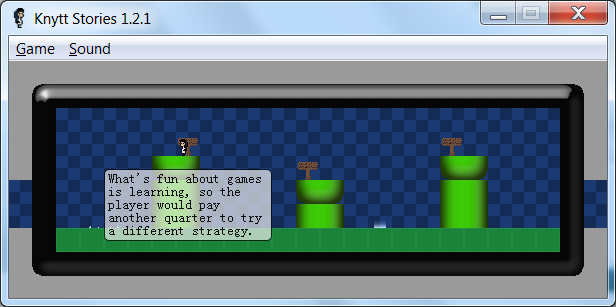
  • What’s fun about games is learning, so the player would pay another quarter to try a different strategy.
  • Players were good about learning, but games weren’t always very good at teaching.
  • Asking the player to learn grew naturally from the challenge, so designers didn’t have to work as hard to teach.
  • Since arcades began disappearing, this idea has made a 180.
  • Designers now want players to play as long as they want without getting frustrated.
  • Though the goals have changed, what’s fun about games hasn’t: learning to become better.
  • This sort of put designers in rough spot.
  • They want their games to be engaging, but they don’t want the player to fail and quit.
  • Games accomplished this by becoming better at teaching.
  • Challenge and complexity increase at such a rate that the player barely realizes they’re improving.
  • But challenge and complexity have to increase so that the player stays engaged.
  • A good game is a good teacher.
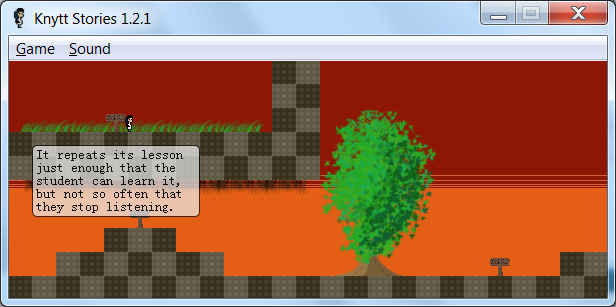
  • It repeats its lesson just enough that the student can learn it, but not so often that they stop listening.
  • If this sounds difficult, that’s because it is. You can’t get there by simply having a cool idea for a game.
  • And you can’t REALLY teach by throwing a bunch of signs up in place of a powerpoint.
  • You need to let the player learn through play.
  • You have to think about what the player is going to do when presented with a certain situation.
  • You have to account for the choices they make with an interesting and believable outcome.
  • Push D to use this umbrella!
  • It’s not something you get better at by programming game logic.
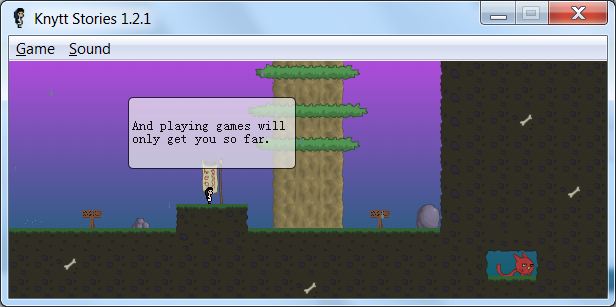
  • And playing games will only get you so far.
  • You have to design levels to improve.
  • You might design so that the player goes right, when in actuality they tend to go left.
  • This has obvious and direct parallels to software usability testing.
  • But that’s a talk for another day and another game.
  • It’s boring to have dead ends.
  • So you’ve got to lead them somewhere interesting.
  • For now I’ll leave you with this:
  • Remember how I said that you don’t need to program to make games?
  • This game, Knytt Stories, (including its level editor) was made using a drag and drop tool.
  • By one Person.
  • There’s no reason you can’t make something even better!
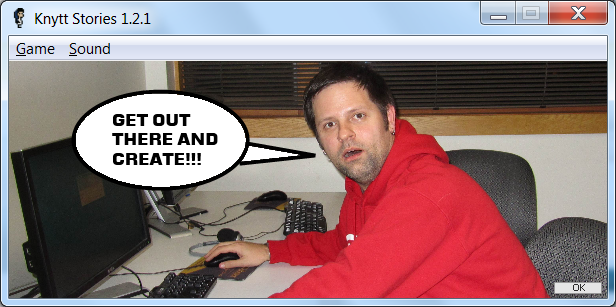
  • Get out there and create!
  • Thanks for playing!

And that’s it for the game! After the lunch and learn we had an interesting conversation about what constitutes teaching and learning within the context of a game. If you’d like to continue the discussion or have any other comments about the text of the presentation please leave them below. If you’d like to give a similar presentation, contact me and I’ll do what I can to help.

As a bonus for reaching this far I’m posting a link to a Kyntt stories level I made a few years ago as part of a forum I frequently visit. The idea behind this level was that several different people would all work on different parts of the same level with no forehand knowledge of what the person before them did. The person in charge of the idea sent out a template with all of the other sections blocked off, leaving you no idea what they did. The result is a varied, uneven level that’s surprisingly fun!


07
Mar 11

Game Design Using In-Game Editors

On the evening of Monday March 7th I gave a talk at the St. Louis Game Developer MeetUp Group about using in-game level editors as outlets for game design creativity. The theme honestly felt like a bit of a stretch, but it’s a lesson I think a lot more people should pay attention to. It may seem like I’m preaching to the choir since this is a game developer meetup group, but we have a lot of nontechnical attendees who sometimes seem to get lost in the more advanced talks.

Regardless, I think everyone should hear this. A lot of people want to be game designers, but when it comes down to it, the most common excuse is that they aren’t an artist or a programmer. That excuse is getting further and further from legitimacy every single day, and this talk is meant to be a motivator that broadens people’s understanding of what’s possible in easily available, high-level toolsets.

I would publish the text of the talk here, but the talk wasn’t actually done in text – a majority of it took place within or surrounding levels I designed specifically for this discussion. To experience the talk, follow the steps below. If you would like to forgo the level creation part you can simply read along by downloading the level in a Knytt Stories importable format, but I suggest following the steps below for the full experience.

  1. Download version 1.2.1 of Knytt Stories and unzip it into a local directory
  2. Drop the contents of this zip file into the “Worlds” directory
  3. Launch Knytt Stories and start playing. Come back when you get to the level editor part and I’ll explain what you need to do. This section should be blatantly obvious.
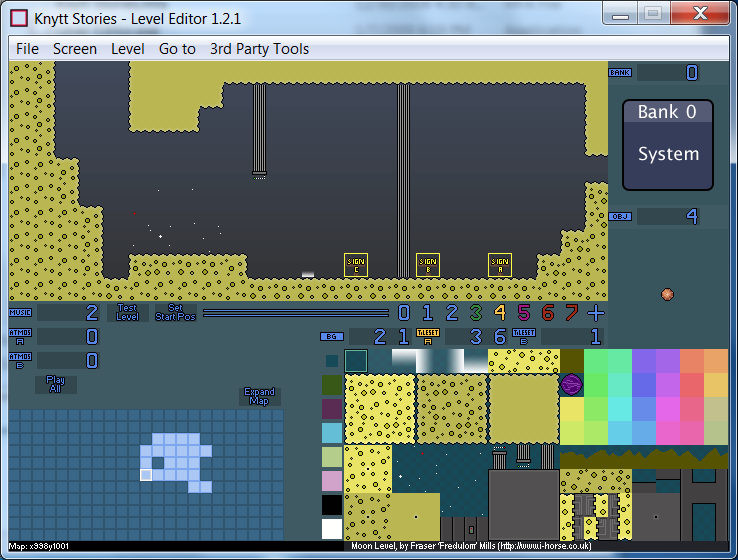
  4. The editor should look like the image below. If it doesn’t, navigate to room x998y1001 using the arrow keys or by clicking on the map in the lower left to select a room to edit. It should look like the picture below.
  5. Select Object 4 from the system pallet. To do this, make sure that Bank 0 is selected (far upper-right), and left click on the “OBJ” number below it until OBJ 4 is selected.
  6. Now click on the play area to place the Wall Climb ability wherever you would like (preferably on the ground).
  7. Choose File > Save or hit Control-S to save the game.
  8. Launch the game again and continue from your last save.

You’ll notice that this demo doesn’t have very many enemies or opportunities to die. I did this on purpose because the demonstration would not have been very interesting for people to watch if the player kept dieing. Knytt Stories has plenty of enemies available though, and you can make some seriously devious levels. When you’re done reading get to it!

After the Knytt Stories part of the talk I showed off some levels I created in the PS3 game Little Big Planet 2. I didn’t do this to show how cool I am (but I am pretty cool!), I did it to demonstrate that getting a level from your head into game form isn’t as hard as you might think. You’ll need a PS3 and a copy of Little Big Planet 2 to fully experience this, but if you don’t have one you can still get the gist of what was created by reading on.

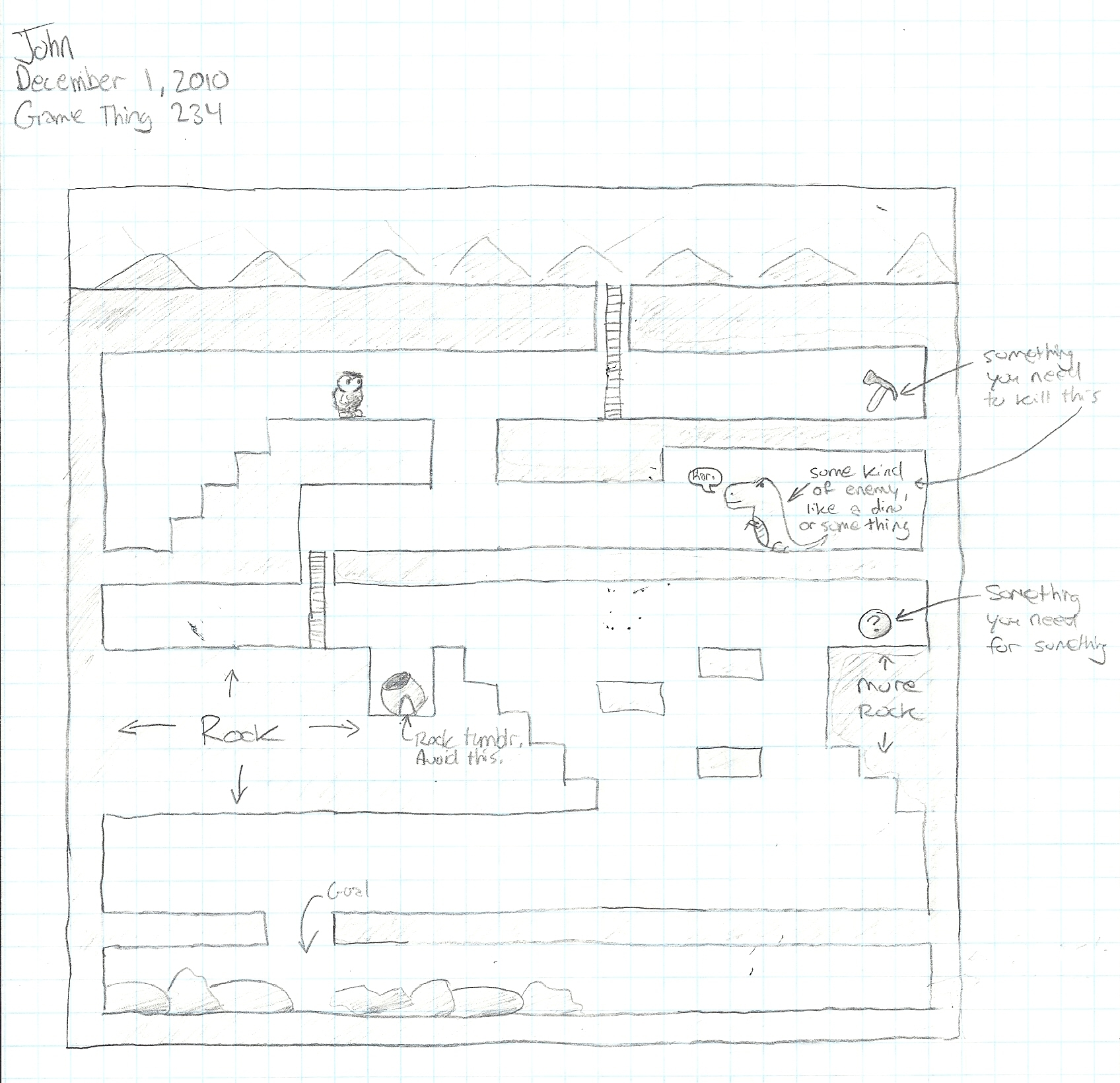
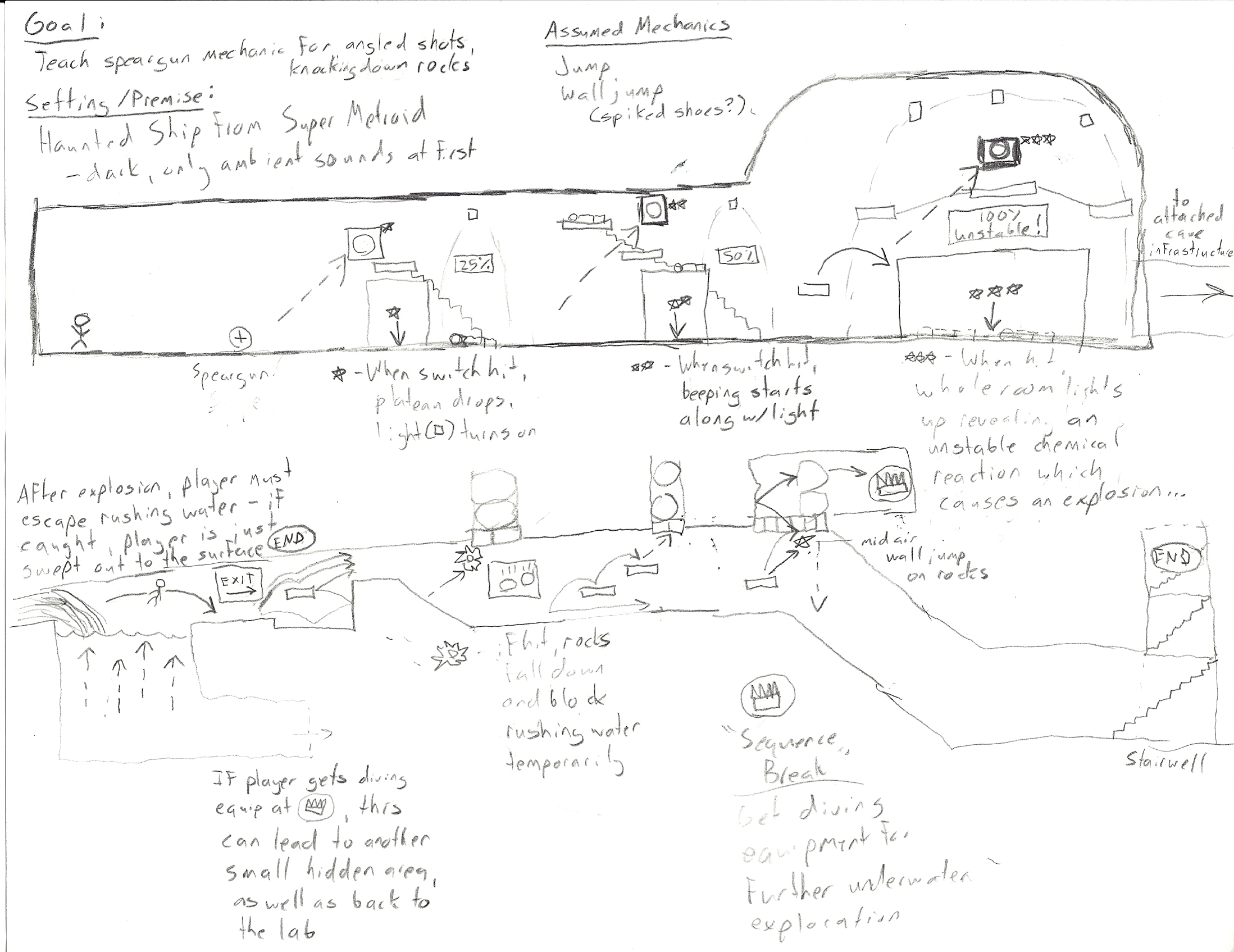
A few months ago, the members of our MeetUp group drew levels on paper for a platformer we’re slowly working toward creating. Moving these levels from concept to implementation in Little Big Planet 2 took just a few nights. Below are the levels that were drawn up, followed by links to the Little Big Planet 2 equivalent. You can add them to your Little Big Planet 2 game directly from the links.

John Anderson’s Level Design
John’s Rock Level


Steve G’s Level Design (only the top half was made)
Reactors

I embellished each of these levels slightly to make them easier to implement and more fun. In the first one I added a lot of collectibles to give people a reason to explore the empty space. In the second level there weren’t explicit instructions on how the platforms should act, so I took the liberty of making the movement of the platforms into a puzzle itself. Watching where they go and how their actions change as you destroy the reactors is a big part of what I’m hoping makes this level interesting. The core idea of the original level is there, but it’s enhanced to give the level a theme of increasing chaos as the reactors are destroyed.

I think everyone got something out this discussion, but even if they didn’t, at least I had fun making the levels. There’s a lot going on in the St. Louis Game Development scene right now and I don’t want anyone to feel like they can’t be a part of it. I genuinely feel that everyone can make games, and if you’re not already a part of the scene the best place to get started is by attending the St. Louis Game Developer Meetup. Scratch that, the best place to get started is by creating something today. Grab some tools and get started!

Relevant Links from talk:

Meetup Page for this meeting

Knytt Stories Download

Auntie Pixelante Indie Games Rant

Little Big Planet Community

Multimedia Fusion Homepage

News on the Infamous 2 Mission Creator


28
Feb 11

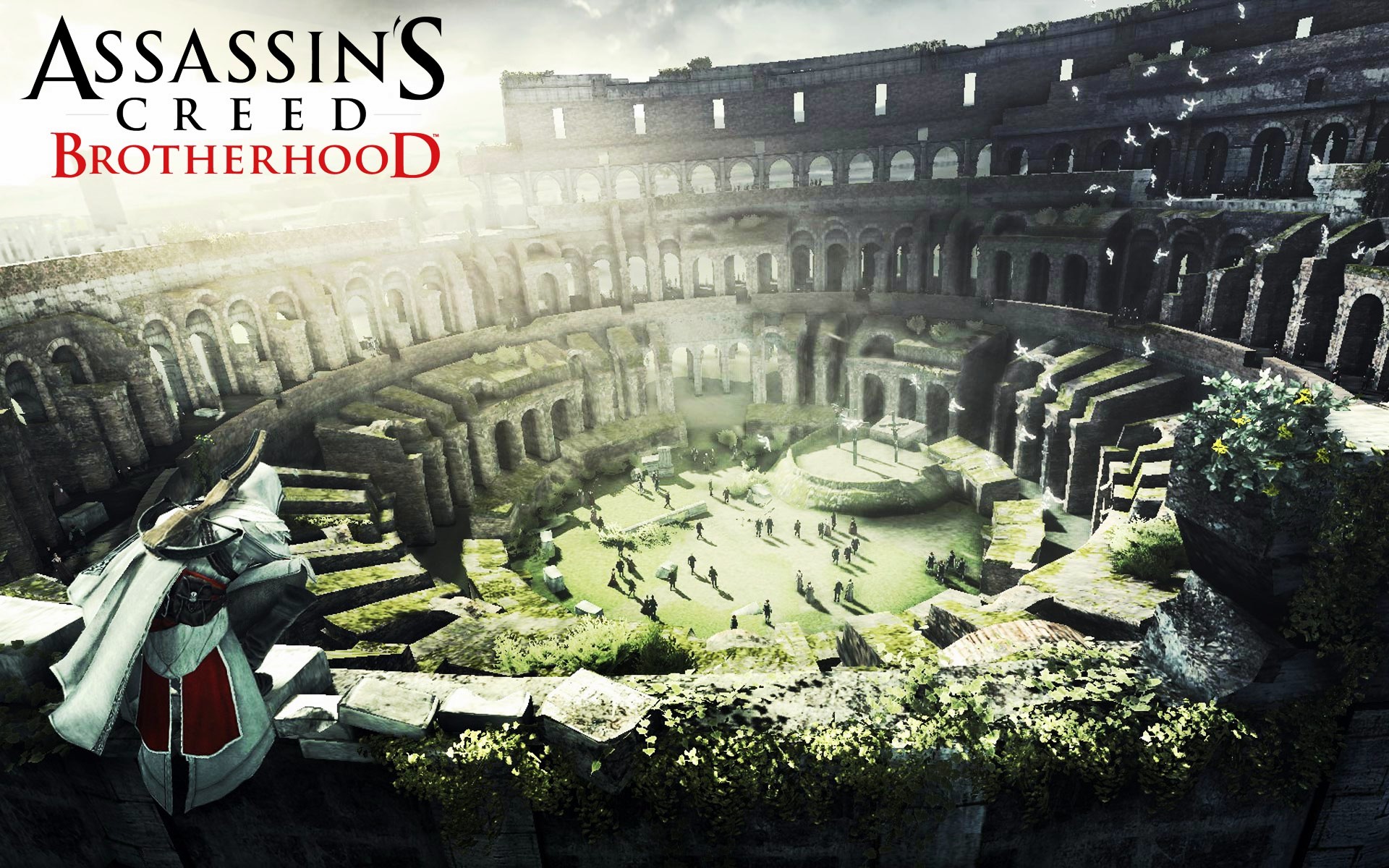
Assassin’s Creed: Brotherhood – Completion Log

Assassin’s Creed: Brotherhood isn’t quite what I’d hoped for, but that seems to be a running theme with this series. It’s hard to say whether or not I would suggest it, because your takeaway is going to depend largely on whether or not you want more of the same. Brotherhood doesn’t stray far from Assassin’s Creed 2, and that’s either a good thing or a bad thing depending on where you’re coming from.

Before I get too deep into my feelings on Assassin’s Creed: Brotherhood I want to take a look back at my feelings on the first two games. When I finished Assassin’s Creed 1 I wrote the following at The Gamer’s Quarter:

“It’s not very good, but I’d say it was worth playing… I’m hopeful that the second game can clean up some of the flaws. Part of what I was looking forward to while playing was finally having the present-time main character get access to the abilities he’s learned in the Animus (that’s the thingy that sends him to the past-time world), but this game never did that. I thought for sure that the final sequence would be your character waking up, discovering all of his powers, and then scaling the enormous office building that he’s being experimented in. They did something like this at the end, but it was lame and the majority of your reward comes from checking other people’s e-mails after they leave the room. Oooh boy! Oh well. Since it’s Ubisoft I think I can safely assume that there will be a sequel in early 2009. Here’s hoping it all takes place in the present!”

Scaling the office building never happened in the second Assassin’s Creed either and the game actually had you spend even less time in the present than its predecessor, but it was a much better game. Here’s what I had to say about it:

“It’s an excellent, excellent game, but not perfect. Near the end I started to feel like I was being put through busy work, but 90% of the game was totally engrossing. Polished to an outstanding degree, freeform without sacrificing structure, and a seemingly endless series of unique missions that explore every possible use of a lot of interesting mechanics… I see myself picking up the sequel whenever it comes out. If the leap is as big as the leap between the first and second games let the froth never end.”

Again, Assassin’s Creed: Brotherhood isn’t quite the sequel I expected. Rather than having a leap as big as the one between the first and the second, it’s basically an expansion pack to the second game with new missions, a different story, and a Farm Ville-like real-time Assassin training mini-game integrated into it. This wouldn’t be so bad, but surprisingly early on Brotherhood begins to feel like busywork. This feeling comes from the lack of a strong story to string you through from location to location, and a near-removal of the leaping between time periods that makes finally completing story chapters so rewarding.

What I’d wished for most in the first game - Desmond finally waking up to his ancestor’s powers in modern times – is the thing Brotherhood gets totally right. He’s finally fully capable of scaling walls, leaping from place to place, and potentially stabbing some dudes in the neck. Too bad there’s never any enemies for him to try his knife out on. Brotherhood gets away with modern day action on-the-cheap by having Desmond travel to the same locations that Ezio goes to in the past. Reusing the assets was certainly done at least partially out of budgetary concerns and laziness, but experiencing an area through both past and future eyes is something I enjoy immensely. It makes the world feel more tangible, even if it is just a series of platforms to re-navigate.

Another surprisingly successful addition to Brotherhood is the aforementioned Farmville-like Assassin rearing mini-game. Although this sounds like a recipe for disaster, the way it’s implemented is rewarding in the same way games like Farmville tend to be – you’re given cool stuff just for hanging out. In Assassin’s Creed: Brotherhood, only time playing the game is taken into consideration, but the countless optional missions make this time speed by. This is both a blessing and a curse though, as these optional missions and mini-games add to the feeling of busywork that I’ve mentioned above. It’s hard to say whether the payoff is worth it, but the addictive “just one more” feeling is effective nonetheless.

The biggest failure of Brotherhood is the plot itself. It feels like an incidental subplot that might have taken place during Assassin’s Creed 2 that has been stretched out to span an entire game. The first few hours are a confusing mess, and by the time it finally settles into a groove you’re left feeling like a pawn in a war that never mattered. Assassin’s Creed 2 strikes the perfect balance between personal and political, but Brotherhood never gets around to feeling personal and suffers for it.

It’s interesting to go back and look at how Brotherhood measures up to what I wanted from the first few games. Had I not played the second one it might have been amazing, but as is, it was merely good. With my time being split between family, making games, and playing them this isn’t always enough any more. As for what I want from Assassin’s Creed 3, I predict that it won’t be the dramatic improvement in design that I want, you still won’t spend enough time playing as Desmond in modern times, it will continue to take place in a European city that I could care less about, and that whatever it ends up being I’ll play all the way through it, whining at least a bit about what I hoped it would be.


31
Jan 11

Lil’Bro vs. DinoStuff – Made in 24 hours

My New Years resolution was to make at least one post a month. I guess I’m sticking to that, but it really wasn’t my plan to wait until the last day of the month to post it. I have a good excuse though, honest! I spent much of the month planning and organizing the St. Louis Game Jam, which went on over the weekend. Around 40 people from all over St. Louis got together and made some pretty great games in around 24 hours under the theme of extinction. I blogged the event over on the Jam’s site and I don’t want to restate it all, so when you’re done here click on over to stlgamejam.com and read what I wrote. It’s like 4 blogs in one!

The game my team made is called Lil’Bro vs. DinoStuff, and it’s a stylistic Score Attack game about a meteor that flies around quite literally slicing the stuffing out of the last remaining dinosaurs on earth. The dinosaurs are all stuffed animals, and when your sword collides with their bodies a burst of stuffing is emitted that shoots out in a random direction until it fades away.

This was a departure from my usual game design method. Usually I begin with a set of mechanics and systems that I want to validate the enjoyment of, but we began with the ridiculous premise and just ran with it, adding in as much cool stuff as we could think of. It’s a lot more style-over-substance than I’m used to, but I think the final game ended up being pretty fun. Premise-first development allowed us to find what works and iteratively design the game around that, rather than create complex gameplay interactions that might be too convoluted for their own good like I did in last year’s GameJam game.

The thing I’m probably most happy with was our team’s ability to evolve the game from a single enemy type, placed randomly, to three separate enemy types with scripted spawn times and positions in less than two hours. The amount of hackery involved in accomplishing this feat was legendary, and I’m much more confident in my ability to solve tough problems with creative solutions by myself now.

If you’ve got a Windows machine and you’d like to play a silly score attack game, please download Lil’Bro vs. DinoStuff. Post your feedback and scores below! Also check out our site’s other games. There’s some good stuff in there!


30
Dec 10

2010 Year in Review

2010 has seen a lot of changes both big and little that culminated so subtly that I didn’t notice how different things are until this reflection.

My job has changed drastically this year as I’ve moved from being a developer on a team of developers to being the sole technical member of a more free-form R&D team. I’m working for the same company I’ve been at since 2003, but now I’m working at Scott Air Force Base in Illinois, which has increased my drive a bit. I assumed this would be a huge change, but at the end of the day it’s still just going to work every day. I’m certainly thankful to have a job in the current environment, so it’s hard to complain.

My family’s relationships have shifted around a lot this year as well. I won’t get into it here, but it’s made me thankful to have a wife who is so down-to-earth, intelligent, and supportive. I don’t think I’d be able to handle things so well without her.

And finally, I swear the amount that babies sleep decreases so gradually that you barely notice your free time deteriorates to almost nothing as they get older. I’m thankful for the slow change though, because otherwise I’d be really pissed. I’ve had enough time to experience quite a bit of entertainment though, so here are my _____s of the Year.

Game of the Year – Halo Reach

Years with Halo games released have the unfair advantage of basically automatically winning GOTY (Game of the Year) from me. It’s not that Halo games are so much better than everything else, it’s just that I’m in a very unique position where I work (worked?) in an environment where we have four system linked Xbox 360s and play 16-player networked Halo at lunchtime. It’s an environment that would turn most-anyone into an avid Halo fan.

Given my situation, it’s not a big deal that Halo Reach is generally more of the same. The class-like loadouts and the ability to use jetpacks is great, but my favorite addition is the updated Forge. I spent hours making maps in Halo 3′s Forge and those maps usually didn’t go over so well with my Halo crew because the lack of precision in the tool meant that people always seemed to catch on walls or fall through floors. The Halo Reach version of Forge lets you float environment items in space, overlap their positions, and explicity enter coordinate positions, letting you choose exactly where you want things. It’s not perfect, but it’s good enough that people at work aren’t diametrially opposed to trying out new custom maps.

Halo Reach is Game of the Year for the way it acts as an outlet for my game design creativity.

Movie of the Year – Scott Pilgrim vs the World

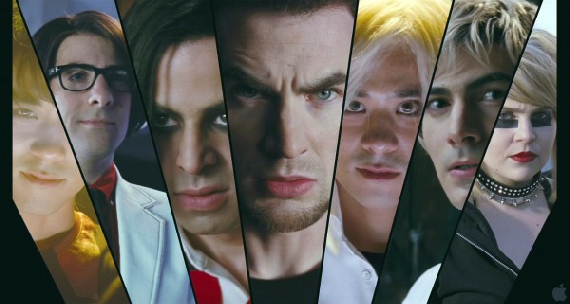
I made a post on the forums (secret hidden area, sorry guys) that Scott Pilgrim vs the World would be the best movie of all time shortly after I saw the first trailer. I was joking at the time, playing on the fact that it focused on everything I love, from cheesy love stories, to Street Fighter, to a story that’s grounded in reality, but overexaggerated by its narrator’s overactive imagination. But then the movie came out and it was literally a non-stop bombardment of all of those things for the entire duration, with little references to everything I love, from Zelda to Seinfeld, sprinkled in. I don’t care that it’s not a perfect movie. I’m sure lots of people will hate it, but I can say for certain that it feels like it was made for an audience of me and me alone, and I don’t see another movie with its finger on my pulse happening again ever.

Best movie of all time.

TV Show of the Year – Vampire Diaries

This year we’ve started watching more TV than my wife would like to admit, making this a hard call. Community, Parenthood, and Modern Family were all great, but my favorite show of the past year (or two) has been Vampire Diaries. It’s sooooo good

When it first came out we started watching it ironically, to make fun of how bad a show that so blatantly rips off Twilight could be, but it turned out to be really addicting. It is a bit like Twilight, but the main character responds to her boyfriend being a vampire a lot more realistically. Instead of silly high school unconditional puppy love, Elena responds to her family being constantly put into danger by trying to stay the hell away. It makes a lot more sense!

But the real draw, sadly, is the whole soap opera draw of watching a love triangle. There are currently around 5 of them going on, and it’s keeping me on the edge of my seat. Sometimes I’m quite simple.

Album of the Year – Forgetters s/t

It’s only 4 songs and it’s only available on record or digital download, but the first release by Forgetters, Blake from Jawbreaker’s new band, is really outstanding. It took a few listens before it really clicked, but the disc hasn’t left my car’s CD player since my wife bought and burned it for me on my birthday in late September. I still pick up on subtle lyrical gems nearly every time I listen to it. I can’t wait for a full album!

Group of the Year – The St. Louis Game Developer Meetup Group

The St. Louis Game Dev Meetup Group was reinstated and reinvigorated with the help of a small company named WorldKi. Our monthly meetings have been extremely fun and I’ve been an active participant, helping to organize the STL GameJam, putting on presentations, getting my friends and coworkers to come check it out, and starting a collaborative game project with everyone who comes to the group.

I really hope this community can continue to grow and St. Louis can blossom into a game development hot spot. We’ll see!

Event of the Year – Watching my daughter begin to learn new things and become a real person

As of this week Elliott will be 19 months old. In the span of just one year she’s learned to walk, talk, eat food with a spoon and fork, play by herself, tell us “no”, and intentionally harass the dog. She’s become a real person!

I was told that it was cool, but until you experience it yourself you’ll never really understand. The best part of my day is getting home from work and hearing her yell, “Da Daaaaaaaaaaaaaaaaaa,” and demand, “Up, up!”

Resolution of the Year – Keep this Website going

I’ve really enjoyed getting this site running again, and I want to keep it up. So that’s my resolution I guess. I resolve to post at least one post every month in 2011. We’ll see how it goes! Keep reading and start commenting!

-Wes


17
Dec 10

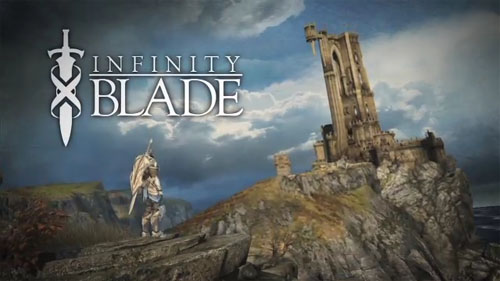
Infinity Blade – Completion Log

This is on a Phone?!

That’s one of the Game Center achievements you can get in Chair’s Infinity Blade for the iPhone. The task it’s attached to is playing through the game 20 times, but the sentiment behind it comes from the game’s outstanding beauty. Infinity Blade is the showpiece for the Unreal Engine III on the iPhone, and, to put it succinctly, that means developers can make iPhone games that look about as good as high-end console games. Infinity Blade is certainly notable for its graphics, but for me it’s just as notable for how Chair understands the nature of gaming on a non-gaming device.

Infinity Blade is, in essence, Punch-Out!! the RPG. The fighting consists of watching your opponent for how they are going to attack, dodging, blocking, or parrying in the right direction, and counterattacking to do some damage. Instead of rounds, there are short cutscenes, and instead of doc riding his bike behind you, there are navigation sections with hidden bags of gold and health potions that allow you to upgrade your character.

One cycle of the game lasts between 15 and 30 minutes and culminates in a boss fight that sends you back to the beginning if you lose. The next cycle allows you to retain your equipment and stat upgrades, and makes all of the opponents more difficult, but also more lucrative to defeat. It’s this short time frame that makes the game perfect for the road. You can fight through a single enemy in the bathroom or play through a quick cycle before bed.

The entire interface consists of tapping or holding to dodge, block, or stab, and swiping to attack. Overall the controls are very tight and intuitive. This is where Infinity Blade gets things right. Other games that try to bring the console game experience to the phone begin by deciding where to place the virtual controller and/or how to emulate the analog stick using the accelerometer. In my experience these things just don’t work.

Take, for example, the “other” showpiece for iPhone graphics that came out last week. It’s a toned down version of Rage, the next big FPS by the creators of Doom. Rage attempts to simplify things by removing the ability to move, leaving only aiming and shooting. In this game, aiming is done by either swiping your finger across the screen or by tilting the phone using the accelerometers. Because precision aiming is at the core of this design, neither of these methods work very well at all. Fighting for precision with imprecise controls becomes the game, and actually making and executing decisions takes a back seat.

What gives a game depth isn’t a high button count or requiring precision aiming, but the feeling that there’s still more to learn. That’s where Infinity Blade excels. When an opponent attacks, you are given three ways to avoid those attacks. Near the bottom of the screen is a block button. This button will block almost any attack, but you’re given a limited number of uses. This is the “easy” option. The “normal” option is the dodge. Dodging allows you to avoid taking damage, but most attacks require that you dodge in the correct direction, making it essential that you watch your opponent closely. The “hard” option is to parry. Parrying requires that you swipe in the opposite direction of your opponent’s attack. Parrying is very hard, but will dizzy your opponent, allowing you to get in several hits.

I spent most of my time in the early part of the game trying to perfect the parry. It was so hard that I eventually reverted to dodging. This is now how I handle most attacks. When I did finally defeat the final boss I did so by dodging attacks until the final round, then taking the easy way out and blocking everything I could for the victory. It’s juggling these three mechanisms where the depth comes into play and the design really shows its strength and versatility.

I’ve played through the game 8 times now, one of those was immediately after beating the final boss, and I’m sure I’ll continue to come back to the game to perfect my parry and level up my equipment. Maybe some day I’ll get that achievement for playing through it 20 times. And this is on a phone!


15
Dec 10

Fable III – Completion Log

WARNING: The following contains spoilers that will ruin Fable III for you.

I became King in Fable III for the Xbox 360 on Nov 1, 2010. This was the day before the midterm elections, and I remember that fact vividly. The first half of Fable III is basically the same as Fable II. You play through a story and eventually become king. The difference here is that once you become King you are tasked with making the same sort of difficult decisions a King would have to make. Err, let me correct that – it’s not quite the same type of decisions, it’s more the weight of the decisions.

But lets go back to that election. Choosing who to vote for was fairly easy, but also on the ballot were several propositions and amendments. These included whether or not to give Property Tax Exemptions to Disabled Former Prisoners of War, changing the rules regarding earning taxes, prohibiting taxing home sales, and changing the laws regarding puppy mills. The way many of these were worded and attempting to consider all of the potential repercussions made it very difficult to just answer yes or no. These laws seemed pretty clear on the surface, but I didn’t know enough about how things are currently structured or how badly Missouri needs money to take a strong stance. I voted against puppy mills because, you know, puppies are cute, but I left almost all of the other boxes blank.

In Fable III, leaving the boxes blank is almost never an option. You’re forced to decide between things like a brothel and an orphanage, deforestation or a sewage treatment plant, and removing all taxes on liquor or outlawing drinking altogether (full disclosure: on that last one I chose the neutral option and just kept the taxes). These seem pretty cut and dry, but the game makes the decisions harder by forcing you to actually pay for your benefits to society. To give those decisions even more weight, on your first day as King you learn that in exactly one year, a plague will come and wipe out any person that you don’t have the resources (money) to protect. How the money protects people is vague, but it’s clear that you need to have $6,500,000 in the bank a year from becoming king if you want to protect your people.

It’s this balance between short-term happiness and long-term health that gives your decisions weight. Do you save everyone’s life by creating a world that isn’t worth living in, or do you create the perfect world for a bunch of goners? That’s what the game’s big question is and it’s effective.

That is, it’s effective until you start reading up on things. You see, soon after I reached the king section I happened upon a Fable III thread where someone complained that Day 120 was the last full day, and after that day you would no longer be allowed to put money toward saving people. I wanted to pretend like I never read it and play the game the same way I otherwise would have, but I couldn’t lie to myself. I still made all of the decisions the way I believed I would have, but I ended up changing the way I played the actual game with that date at the front of my mind. I bought every single house in the game and lingered through side missions and cultivated pointless in-game relationships while my money grew, so that by the time I hit day 120 I had almost exactly the right amount of money.

I finished my last mission, played through the endgame, got the good ending, and felt empty. Part of this was the unfulfilling endgame, but the majority of it was that I had taken this experience which was designed around making your decisions feel less like binary game options and had reduced it almost entirely to binary game options. When the decisions felt like the same type of decisions I was making in the election I was overjoyed. I cared! This is ultimately the greatest achievement of Fable III. There’s a time when you actually care about your subjects. But all of that goes away when you inevitably begin turning those decisions into a game again.

I believe that the reason the game ends on day 120 might be because the designers want you to rule with your gut instead of your head, and they want you to get the ending your heart would have led you to. I wasn’t given this luxury, and Fable III ended on a sour note as a result.

I’ll never know exactly how I would have felt had I not happened upon that forum post, but if you’re reading this, I apologize for ruining the game for you. Now that you’ve read this, it’s probably not worth playing.


17
Nov 10

Top 10 PS2

The Playstation 2 turned 10 on Oct. 26th and I celebrated by starting a blog post that wouldn’t be completed until November 17th.  Oh well, that’s how life goes sometimes. Here are my top 10 favorite PS2 games. As I picked them out I was most surprised by how relatively few of the several hundred PS2 games I own that I’ve actually completed. This isn’t representative of the quality of games on the PS2, only that my tendency in those days was to quickly move from game to game, only playing them long enough to get the gist, or until they began to present a challenge that I didn’t feel like overcoming. I also bought anything that seemed like a good deal, even if I knew I had no desire to ever really invest any time in it. Anyway, these are games I can confidently state that I did invest time in, and felt it was time well spent.

  1. Katamari Damacy
  2. From the moment you see the erupting rainbows and dancing bears and geese singing the glorious theme song you know that Katamari Damacy will be a delightful experience, and it never disappoints. The concept is simple: push both of the analog sticks forward to move a ball forward, rolling into anything smaller than the ball, allowing you to pick it up and grow larger so that you can pick up even bigger objects.

    Convincing yourself that it’s the gameplay of Katamari that matters is tempting, but really it’s the way the simple design keeps your mind churning, searching for the next biggest item (but not too big), while your brain and eyes are bombarded by the happy music and the urge to try to make sense of the ridiculous scenarios the player is disrupting.

    The greatest achievement of Katamari Damacy is how the entire game is structured around building up to a massive last hurrah. In each level you are asked to make your ball larger than the last, climaxing in a final level where you’re given something like 20 minutes to progress from gathering tiny thumbtacks to picking up enormous oil tankers and fluffy clouds. It’s impossible to play without a smile on your face, and that’s why it’s at the top of my list of great PS2 games.

  3. Metal Gear Solid 3: Snake Eater
  4. My favorite part of Metal Gear Solid 3 takes place about half-way through the game. You’ve infiltrated your way deep inside of the enemy base and you’re making your way back out by climbing a ladder. The ladder climbing goes on for more than two minutes. Shortly after you begin climbing, a woman starts singing the theme song. It’s a 007-esqe spy love song whose chorus is a reference to the game’s “Snake Eater” subtitle (which came first, the title or the song, we’ll never know).

    During this scene your mind is constantly wondering what is going on. The game has just settled into a groove and you’ve just finalized your decision to play the game with stealth or with shotgun-to-the-face aggression. It breaks your groove, and you start to wonder, “am I doing this right? What if I stop moving, would the song go on? Is the game broken?” And when you get to the top you’re instantly thrown back into the action, with helicopters and manned turrets all aimed right at you.

    This scene is amazing for the way it comes out of nowhere forcing you to think, even for a moment, about your role in the game and the game’s role as a game. Not many games are willing to try that, let alone succeed.

  5. Shadow of the Colossus
  6. I first played Shadow of the Colossus at E3 shortly before its release. The E3 demo put you on a horse near the first colossus and gave you no direction. A few people had been walked through defeating the colossus by the Sony reps, but me? I just wanted to try out the controls.

    E3 is an interesting place to play games because you’ve generally got five minutes or less to play a game and take away as much as you can from the experience. With a complex, deeply layered game like Shadow of the Colossus, this is difficult.

    For starters, there’s the controls: The game has the most common moves mapped to simple, easy to understand buttons, but if you want to do anything beyond running and jumping you’ve got to contort your hands into ridiculously complex positions. I spent my 5 minutes learning how to get the horse running, then learning to stand up on the horse and shoot arrows at the colossus. You can’t harm the first colossus with arrows, but that didn’t matter. The joy of putting together all of these moves into this acrobatic feat, and knowing that I did it myself without any instruction made me know that I was playing something special.

    When the final game arrived months later, it took this joy and added a world with a strong sense of versimilitude and a tone that gracefully fades between serenity and brutality. Like Katamari, it’s hard to play the game without a smile on your face, but in this case there’s a certain sadness beneath that smile.

  7. Devil May Cry
  8. I was at Brady Games working on the Final Fantasy X strategy guide when the Devil May Cry demo arrived. I had been following it, but I had imagined a more stylish Onimusha. What I got was the first 3D action game that captured the tight controls and fast action of a fighting game without sacrificing the narrative progression of an action game.

    I’m not sure exactly why, but I don’t believe anybody has been able to successfully capture the feeling or the balance between humor and “coolness” of Devil May Cry since.

  9. Disgaea
  10. Final Fantasy Tactics was a revelation for me. It was like someone took a complex game like chess, made it even more complex, added in the draw of a scripted story, and released it as a videogame. It was so complex that if you tried hard enough and pieced together the game’s systems in the right way you could become all-powerful with little effot, but you’d have to really think it through to do so.

    Disgaea was the next evolution of that. They took the basic mechanics of a tactics game and, sloppiness be damned, added in layers of depth. You could travel virtually anywhere on the board from the very start by picking up other characters and throwing them. You could clear entire boards by solving a puzzle game that lives inside of the colors of the tiles beneath the characters. You could level up characters to insane levels or simply level up their weapons. It’s a lesson in removing the constraints from a game’s design and just letting the systems conflict with each other until something beautiful gets spit out.

  11. God of War
  12. I have a disconnect with others about why God of War is a good game. I was in a conversation last month with a fellow member of the St. Louis Game Developer meetup group about why he likes it. He likes the game primarily for the way it provides so many moves and combos to take out your foes with. I argued that the number of moves doesn’t matter since you can use the same ones to kill anything. No, it’s not the fighting that I like. What I get out of God of War is primarily an appreciation for its storytelling. Although the story itself (a bastardization of Greek mythology) isn’t that great, the way it’s told is a lesson in manipulating a player’s understanding of their environment. A completely linear game, God of War uses the movement and positioning of its camera to guide the player through its environments, subtly guiding the player’s eyes toward whatever the designer intends. There are a few places in the game where you traverse over an environment once, then come back later and barely notice that you’re in the same place because the camera is following you from a different position. These moments are what I love about the game.

    Early on in God of War you run across a grave digger who gives you some quick advice then gets back to work. Later, Kratos is sent to hell and ends up climbing out. When you get to the top you realize that you’ve exited hell through the hole the grave digger was digging. It’s this sort of circular level design that makes a world feel real and makes it feel like your actions are part of a bigger story. This is why I like God of War. For making me think about these things.

  13. Ico
  14. My wife doesn’t like me telling this story, but I tell it all the time. Sorry baby!

    One of our biggest fights ever came early on in our dating relationship when she deleted my Ico save game. She had been watching me play the game, and (despite showing very little interest in games until then) wanted to play it herself. I finished the game the night before and was telling her how amazing the ending was, and when I came back from my classes I found her playing it, only to discover that she deleted my save game. I’m pretty sure I yelled and screamed and tried to make her feel like a moron for not just saving in a different slot or using a different memory card. Clearly it’s strange to feel passionately about something as small as this, but at the time it really bothered me. I think I saw my saved games almost as a body of accomplishments that I was building up over time. The saved games on my memory cards were an invisible body of work that I was creating. This was a time before achievement points, so these cards were all I had to prove my victories.

    I’ve learned now, thanks in part to our fight, that seeing game progress as an actual accomplishment is sort of ridiculous. What matters is how the actual act of playing the game makes you feel, not whether you can put another notch in your belt. If there’s any game that can make you feel, it’s Ico. Our fight isn’t why the game is on this list, that’s why. The way the game creates a relationship between Ico and Yorda using subtle animation hints and cooperative puzzle solving is about as close as anyone’s ever gotten to providing a relationship with an AI that the player actually cares about. Bad box art aside, Ico is a game that everyone should play.

  15. Transformers
  16. Full disclosure: I’m a 32 year old father who still collects Transformer toys. I’ve consciously limited my collection to just the various iterations of Optimus Prime, but now that it’s on the table I can admit that I’m a bit biased when I say that Transformers has a better single player campaign than Halo.

    The comparison is a admittedly a bit of a stretch. Transformers is a third person free-roaming action shooter with platforming elements, while Halo is a fairly strict first person shooter, but the first level invites comparison. It doesn’t look like Cybertron, it looks like you’re on one of the rings of Halo! What Transformers succeeds at is delivering a truly open-ended action game. Almost all of the extremely large, open-air levels are designed with a boss hiding out somewhere waiting to be hunted down. Once you trigger the boss fight you can run anywhere in the level to actually fight it, reinforcing the open-world feeling of the game.

    Once you do a bit of exploring it’s usually pretty obvious where the boss is, but you probably won’t want to stop there. Exploring is where this game excels. Hidden in each level are mini-cons. These are small transformers that give your bot new weapons or special abilities. You can use a limited number of these at any time and can swap them out in between stages. Trying out different abilities and experimenting with different combinations of mini-cons leads to a lot of possible strategies and unique ways of taking on a stage. You’re encouraged to find your own way to play the game, and mine usually involves driving full speed into a decepticon to launch them into the air, and trying to shoot them to death as they fall to the ground – another one of the awesome features of the game.

    Despite being a licensed game, Transformers is an underrated gem that was ahead of its time and still hasn’t had its most unique attributes emulated successfully.

  17. Guitar Hero
  18. My wedding reception was awesome. We had a DJ who didn’t play the chicken dance, a photo booth where everyone could go and get silly pictures taken, and Guitar Hero. Without Guitar Hero we would have never considered having videogames at our wedding reception, but thanks to Harmonix’s key understanding of both music and America, they broke down a wall and made a game that is socially acceptable.

    I can’t put enough emphasis on how American Guitar Hero is. The concept of the guitar music game was pioneered by the Japanese with a game called Guitar Freaks, but Guitar Hero refined that concept in a way that makes it uniquely American. Guitar Freaks’ soundtrack featured a mix of music – some made specifically for the game, some Japanese pop music, and a few licensed American tracks, such as Alanis Morisette’s Ironic. That last one is a perfect example of Japan doing things wrong. When people think of guitar music, Ironic isn’t exactly the first song that comes to mind. In fact, it may be nearly the last. Guitar Freaks attempts to pull in players solely by making a fun game. It succeeds, for the most part, but the song list practically requires that you have an interest in music games before you play it. Guitar Hero went the other route and selected songs people knew and would have been interested in playing outside the context of a game, thus instantly making it more appealing to outsiders.

    Then there’s Guitar Freaks’ guitar itself. It looks the same as the one you use to play Guitar Hero/Rock Band, but it only has three buttons. With three buttons, the feeling of moving your hands up and down a guitar’s neck to create different chords is completely lost. Having only three buttons, Guitar Freaks is forced to place a higher emphasis on rhythm and timing than on finger positioning. It puts the “game” aspect of playing higher than the “experience” aspect, and, ironically, it’s a weaker “game” for doing so.

    With how Activision has been running the brand into the ground, it’s easy to forget what a breakthrough Guitar Hero actually was, but when I look back at the PS2 games that affected my life it’ll always be hard to forget. After all, it’s in my wedding pictures!

  19. Final Fantasy XII
  20. The thing that kept running through my head as I played Final Fantasy XII was how amazing it is that $50 can buy you so much. Final Fantasy XII has tons of depth, looks amazing, has a lot of variety, and has a great sense of pacing. Most impressive is how it fixes the biggest problem present in Japanese Role Playing Games – their insistence on asking you to make non-decisions.

    JRPGs have been broken for a long time. The fun part of playing videogames involves making decisions and learning from the consequences. With that said, think for a moment about how JRPG battles typically play out. You’re presented with an enemy. You attack it and discover that regular attacks don’t do damage. You notice that he’s ice blue, so you attack him with fire. It does critical damage. You’ve now made the connection that ice blue enemies are weak against fire. It was pretty fun! At this point, RPGs trip over themselves by asking you to fight that same enemy over and over again, presenting you with the same decision each time. At this point this option ceases being a decision and starts to be tedious. If you keep playing it’s often not because you’re still having fun, but because you’re too invested in the story to turn back.

    Final Fantasy XII fixes this by taking the making of these decisions and moving it up front to an almost meta level. You make the decision once by programming the secondary characters in your party, and you watch as they perform the actions you tell them, slowly evolving your strategy as more options open up and a greater variety of enemies present themselves. It brings the fun back to decision making, and it allows the design to explore greater complexity elsewhere.

    It’s a very complex game, which lent itself well to the strategy guide that I helped write. I used the money from that guide to buy my wife’s wedding ring, but it’s not on this list for that, it’s here for being such a great game. And sort of like marriage, you get a lot for your money when you stop to think about it.

Honorable Mentions:

  • Final Fantasy X
  • Jak & Daxter
  • SSX3
  • Baldur’s Gate: Dark Aliance
  • Hot Shots Golf 3
  • Makai Kingdom

-Wes


15
Nov 10

Professor Layton and the Unwound Future – Completion Log

Finished the most recent Professor Layton game last night. Professor Layton and the Unwound Future is the third in a series that I like to describe as “a Sherlock Holmes-like story connecting the types of logic puzzles in e-mails your grandmother would send you.” It’s not a flattering description, but it’s true. Penny Arcade sums it up in a comic about the first game:

Pardon the language.

Anyway, as I played through the game, several random thoughts went through my mind. I thought it might be fun to just list out a few that I can remember and let you come to your own conclusions. So here they are! (very minor spoilers present)

  • This is a story about traveling ten years into London’s future. In the previous games there’s always a big give-away that culminates in grounding the more extreme fantastic elements in the real world. It’s going to be hard for them to ground time travel in the real world.
  • The action in this game reminds me of The Castle of Cagliostro. What a great movie!
  • The production values in this game are really great. Sure, it has talking heads, but it knows what moments to emphasize and really plays them up by adding voice or fully animating the conversations.
  • Level-5 are the best game developers left in Japan.
  • I can’t tell if this game is just easy or if finishing the first two games in the series has prepared me for the type of critical thinking present in the Laytonverse, but I haven’t spent more than a few minutes on any single puzzle yet. I have to admit they’ve all been enjoyable.
  • Why did they decide to animate the scene when you meet the talking bee for the second time?
  • Why did they introduce the talking bee twice only to kill it off and replace it with another (better) character?
  • These animated cutscenes are really great. I don’t really watch anime any more, but I would watch a Professor Layton anime any day. (Note: There is one in Japan, but it hasn’t been released in America yet)
  • There are way too many people to talk to that don’t actually have puzzles for you. I wish there was a way to tell at a glance if someone has a puzzle for you. It seems to run at about 50/50 at the moment.
  • There’s an interesting moment about mid-way through the game where you run into a statue that looks similar to Layton and his apprentice Luke. I didn’t read it as closely as I should have, but the impression that I got was that the story in the Layton games are being framed at a meta-level as the story a father is telling to his son Luke. It never came back up outside of that one moment, but if the games begin to take this metaphor and make it more pronounced it could add some depth to the stories.
  • According to the clock I’ve put 13 hours into this game. It feels more like half that.
  • This (optional) parrot delivery mini-game is way too hard! It’s a great concept though.
  • The (optional) toy car mini-game is really fun. I feel like it could almost be a standalone game.
  • The (optional) storybook mini-game is outstanding, but I wish there was something that indicated where to find the remaining pieces of the book. I can’t find any more puzzles!
  • This might be my favorite Layton game from a gameplay standpoint and it probably has the best pacing. If I have any complaints it’s simply that we’re on a third game in a world populated by people whose sole mode of interaction is harassing you with puzzles (see the comic above). The first game tried to justify it by setting itself in a “curious village”, the second game touched on it a bit but then kind of brushed it off, and this game just assumes that your suspension of disbelief is worn down by now. I guess what I’m saying is I miss the moments in the first game where you really feel the ridiculousness of the Laytonverse, where someone will ask you to figure out the ages of their daughters in exchange for the location of a building you’re trying to find. Now that it’s gone it’s impossible to get that feeling back, but it’s something I really miss about my introduction to the series.
  • Oh, so that’s how they grounded the time travel in the real world. It’s what I expected, and it’s happily even less believable than actual time travel. I’m glad it allowed for a climax of sufficient grandeur.
  • Oh man, I’m so tired. I keep falling asleep during the ending. I’m going to have to finish this again later to catch what I miss. Elliott needs to stop waking up at 6:30AM.
  • How can a trilogy end by introducing more questions?

So ultimately I loved the game, but it’s more of the same. As long as these things continue to keep me interested long enough to add them to my completion log I guess I’m ok with that.